
PIGSKIN POLITICS
How Football Can Tackle Gerrymandering
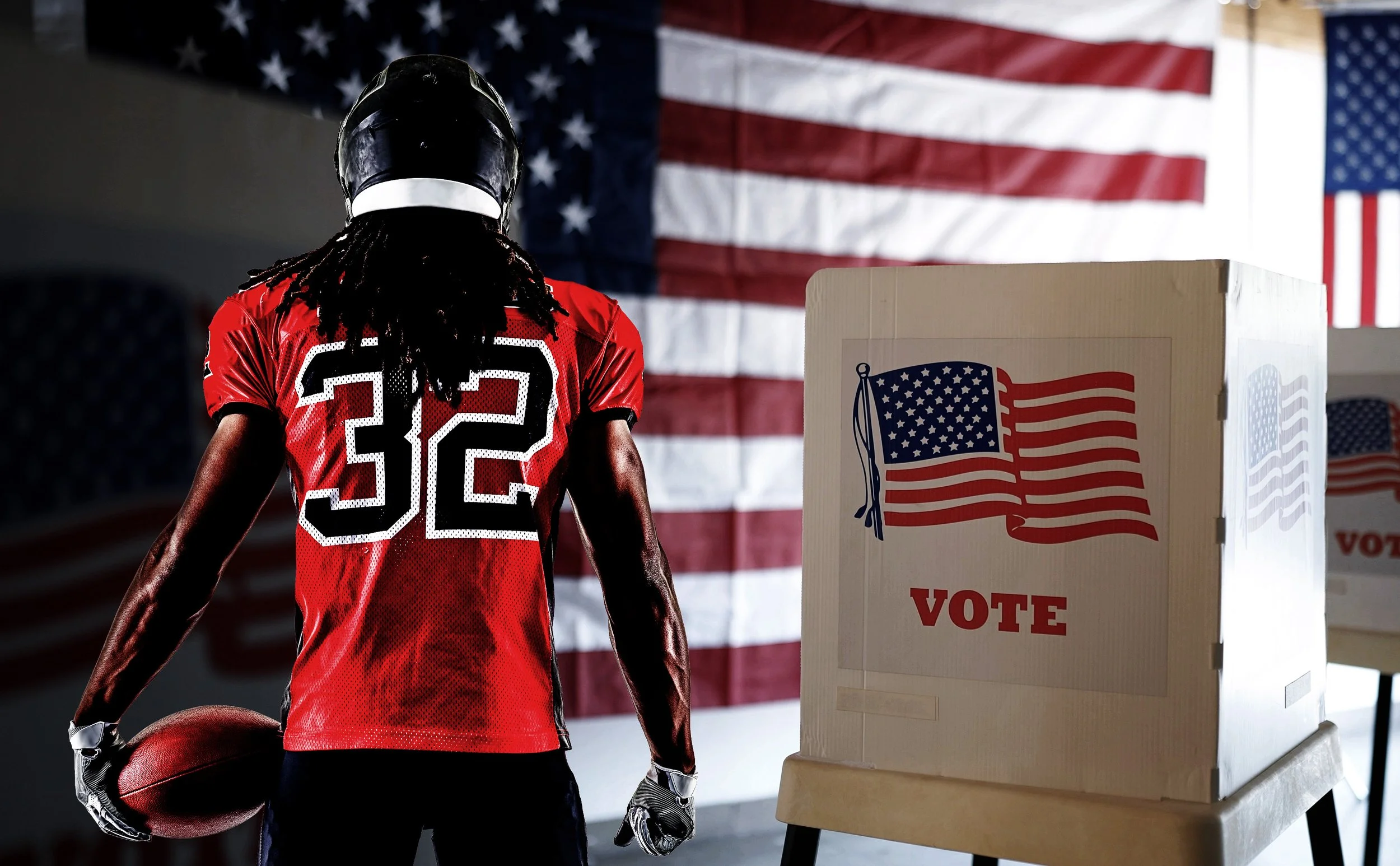
The United States will celebrate its 250th birthday next month, commemorating the July 4th when 56 bewigged representatives of the Second Continental Congress put quill to parchment to declare independence.
For the last few months, one of the signers of that Declaration of Independence has been absolutely dominating news cycles.
But that figure is not Thomas Jefferson, Benjamin Franklin, or another familiar Founding Father. It’s the lesser-known Massachusetts representative Elbridge Gerry.
You know him, of course, because three-dozen years after his 1776 autograph helped launch our nation, as Governor of Massachusetts, he signed legislation that created an odd-shaped, heavily partisan state senate voting district. A clever political cartoonist portrayed this new entity as a fierce, mythological salamander, leading to the portmanteau "gerrymandering."
Today, gerrymandering is rampant, as legislators throughout the country have been furiously birthing new reptilian, redrawn voting districts. They were given free reign to do so by the U.S. Supreme Court’s April decision in Louisiana v. Callais, which effectively guts a key provision of the Voting Rights Act.
Some historical context: The 15th Amendment, ratified in 1870, gave the right to vote to African American men, newly released from slavery. But states used Jim Crow laws to keep them disenfranchised. The Voting Rights Act, signed into law by President Lyndon B. Johnson in 1965, was intended to enforce the 15th Amendment and counter Jim Crow segregated voting districts that essentially rendered African-American votes moot.
But now the Callais decision has opened a Pandora’s box of gerrymandering, particularly in the U.S. south. In fact, of the 11 states that comprised the Confederacy, all 11 have already or are in the process of trying to redraw those districts — and all but one in obvious efforts to draft more favorable outcomes for Republican candidates. (The other state, Virginia, tried to do the same for Democratic voters, as a response to what was happening in the 10 “red” states, but after successfully passing such legislation, saw it overturned at the Virginia State Supreme Court level, a decision the U.S. Supreme Court refused to overturn.)
This new wave of “Crowmandering” is effectively eliminating Black Congressional representation from those southern states.
Passing the Political Football
Whereas the Black vote is being swept under the rug in the South, Black athletes are recruited in the region with the red-carpet treatment.
Few things are more important, culturally, in southern red states than college football (and occasionally, basketball, too). In 2020, ESPN reported that the highest-paid public employee in all but two southern states is a college football coach (the other two are college basketball coaches). The male athletes recruited to play at marquee Division I schools are primarily Black. According to a 2019 survey, Division I college football players are 48.4% African American, 36.5% white, and other 15.1%. In basketball, the number of male African American athletes is even higher, 58%.
What if African American athletes reconsidered attending schools in states that have Crowmandered the vote away from Black populations? Might that disincentivize Black athletes from playing for those state-administered schools?
That idea has occurred to the NAACP, which has called for a Black-student boycott of college sports in the red states that are Crowmandering.
“We're calling for Black athletes, families, alumni, and fans to withhold athletic and financial support from public universities in southern states attacking Black voting rights,” notes their Out of Bounds campaign.
As the NAACP notes further, “Across the South, Black athletes have helped build some of the most profitable college athletic programs in America, generating hundreds of millions of dollars in annual revenue. At the same time, several southern state governments are moving to limit, reduce, weaken, or erase Black voting representation by creating new, unconstitutional voting districts. You can't have one without the other. Profiting off of Black athletes while suppressing their vote is out of bounds.”
The "Out of Bounds" Pledge asks Black athletes to consider vowing, “I will not allow my talent, labor, name, image, likeness, family, or community pride to be used to enrich institutions in states that are working to silence Black voters. Until fair representation is restored, I commit to exploring HBCUs, institutions in states that respect Black political power, and programs that publicly stand with our communities.”
Rebel Without a Clue
Without saying so explicitly, the Out of Bounds campaign seems to be targeting the Southeastern Conference, or SEC. The SEC is a 16-member college athletic conference that has schools in nine of the 11 states that comprised the Confederacy. One of its schools, the University of Mississippi (also known as Ole Miss), has been at the center of a pair of recent news stories that capture the attitude targeted by Out of Bounds.
The first involves some trash talk from other SEC rival schools that began when Lane Kiffin — who up until last year was the coach of the University of Mississippi football team, and who left there for the rival Louisiana State University Tigers — compared recruiting opportunities at the two schools. He noted that many top recruits would tell him they were not interested in coming to Mississippi. "[They would say], 'Hey, Coach, we really like you,’” Kiffin told Vanity Fair. “‘But my grandparents aren't letting me move to Oxford, Mississippi.’ That doesn't come up when you say Baton Rouge, Louisiana. Parents were sitting here this weekend saying the campus' diversity feels so great: 'It feels like there's no segregation.’"
Guessing it’s harder to recruit a Black athlete to the University of Mississippi when the school nickname is the Rebels. Yeah, as in the Confederacy. (The school’s original mascot was Col. Reb, who wore a Confederate army officer uniform. The school has since retired the Col., but “Rebels” is still the current official school nickname.)
Another SEC coach, the University of Texas Longhorns’ Steve Sarkisian, piled on a day later, when he told USA Today that "all you have to do is take basket weaving, and you can get an Ole Miss degree."
The second University of Mississippi non-football football story centered on their recently graduated quarterback, Jaxson Dart, who was drafted two years by the New York Giants. When President Trump recently spoke at a pep rally in the New York area’s Rockland Community College, it was Dart who glowingly introduced him on stage.
That drew ire from a few African American NFL players: New Orleans Saints defensive end Cam Jordan (who played college football for the University of California Berkeley) posted on X in response to the Dart/Trump pairing: “sounds bout ole miss.”
And Dart’s own Giants teammate, star linebacker Abdul Carter (who went to Penn State) was in disbelief at Dart’s cluelessness. "Thought this s—t was AI, what we doing man," Carter posted to X.
Suggestion for states that want their college teams to have a fair shot on the playing field: even the playing field for your politics, too.
UPDATE: June 16
While coaches in the 12 southern schools have not weighed in on the Out of Bounds campaign since it was launched in May — and even LSU’s Kiffin refused to answer a question about it at a press conference — those same coaches went apoplectic about a different ethical issue: a rival school signing a player with a known gambling problem.
The player, Brendan Sorsby, is a talented quarterback — one who, according to ESPN, “placed more than 9,000 bets, totaling at least $90,000, on professional and college sports over four years while enrolled at Indiana, Cincinnati and Texas Tech, including at least 40 wagers involving Indiana football” while he was on the team. Schools across the country called for boycotts of Texas Tech, and the other members of Texas Tech’s Big XII Conference sued Texas Tech and Texas attorney general Ken Paxton, who backed Texas Tech in the off-the-field struggle. (Perhaps it is unsurprising that Paxton, a current candidate for U.S. Senate, backed Tech and the gambling player in question, as he himself is backed by the nation’s most famous former casino owner.)
Texas Tech reportedly signed Sorsby for a reported $4-$6 million under college sports’ new NIL (Name, Image, and Likeness) rule, which allows it to pay players. Texas Tech, powered by billionaire fossil fuel alum and fans, has one of the country’s richest football-supporting programs.
So, if we’re reading the academic barometers correctly here: YES to boycotts if it impacts the integrity of the game, but NO to boycotts if it impacts the integrity of our democracy.
Plot twist: Bowing to a deadline pressure offered by the NFL supplemental draft, Sorsby “punted,” declaring for that draft and leaving Texas Tech, thus absolving it — and pearl-clutching football fans across the country — of at least one moral dilemma. But it certainly seems that political pressure worked in a matter of weeks, while the pressure on gerrymandering has yet to gain any significant yardage.