
Fueling Climate Optimism in … DC?
Photo by Andy He
The most optimistic room I've been in all year was in the city doing its best to destroy the future.
The headlines have been a sustained assault on the planet: rollbacks of protections, scissoring safety nets, and a federal government hell-bent on treating the environment with all the tender care it has given, say, USAID or DEI. And yet a visit to DC Climate Week last month gave me something sustainable I didn't expect to bring home: fuel. Enough fuel, it turns out, to keep going.
That word — “enough” — hung in the air all week, most dramatically from the voice of Indian eco-folk artist and climate-justice poet Neha Misra, who took the stage at the opening ceremonies of DC Climate Week and articulated what so many in the climate community have been feeling. "The cloak of benevolent giving over cruel taking," she said in a delivery of her poem “Enough.” "Enough. Enough. Enough gaslighting that made breathing in your presence shallow enough. Violence of your silence. Enough. Enough is enough. Enough already. I have had enough."
She was certainly venting the frustration of the Global South, as well as the overwhelming majority (85%) of Americans who believe that climate change is real. But the remarkable thing about DC Climate Week was that frustration was not the dominant emotion in the room. It was defiance. And it was progress. And it was respect for the counterintuitive, irrefutable facts.
Eric Wesoff, executive director of Canary Media, gave the in-person audience reason to laugh with a slide featuring "Coalie" — a googly-eyed cartoon lump of coal beaming next to the … sentient lump Doug Burgum, our Interior Secretary. Coalie was unveiled by the administration as a spokesperson for what it calls "Beautiful, Clean Coal." The hardhat reads "Mine, Baby, Mine."

For the love of God, it’s Coalie
"This is because we're winning," noted Wesoff of Coalie’s debut. "It's because they're scared."
He’s absolutely right. For every depressing data set, Wesoff offered a countervailing one of hope: One one hand, Ohio has imposed roughly 40 county-level bans on new utility-scale solar and wind, and a fifth of U.S. counties restrict renewable development. And yet 80% of U.S. solar-manufacturing investment has flowed into Republican-held congressional districts. Trump voters want utility-scale solar. Twenty-four states are moving toward streamlined solar approvals.
The politics and the economics have diverged so dramatically that even the administration's own constituents aren't following the script. Offshore wind delivered reliably during the brutal winter cold that gripped the East Coast. Puerto Rico's rooftop solar — which was referenced in Bad Bunny’s Super Bowl halftime show — is the only thing standing between the island and daily blackouts, even as the administration cancels millions in solar funding there.
Rich Powell, CEO of the Corporate Energy Buyers Association (CEBA) — an organization that “includes the world’s largest companies advocating for market reforms that enable buyers to access clean power” — reported that his members now source 25% of their power from renewables, an all-time high. And CEBA members aren’t tree-hugging idealists — they’re procurement officers with an eye on the bottom line. The market is speaking.
(Meanwhile, far from the DC Climate Week stage in California but more reasons for optimism, Stanford professor Mark Jacobson reported this past week that, just four months into 2026, 80% of days have seen wind, water, and solar meet more than 100% of electricity demand — including 30 consecutive days.)
ENOUGH ALREADY
DC Climate Week was also the occasion for Brooklyn Story Lab partners to take center stage. The nonprofit Climate Curve announced the 20 Keeling Curve Prize finalists competing for 10 awards of $50,000 each — organizations doing the unglamorous, essential work of cutting emissions without waiting for Washington's permission. (The announcement was made onstage during the opening ceremonies of DC Climate Week, by Climate Curve founder and executive director Jacquelyn Francis and Time magazine senior climate correspondent Justin Worland.) And nonprofit Pyxera Global hosted a number of events in their Navy Yard offices, including a panel on urban mining, showcasing efforts to recover rare earth elements and critical materials from devices we've already made, building a domestic supply chain for the clean-energy transition.
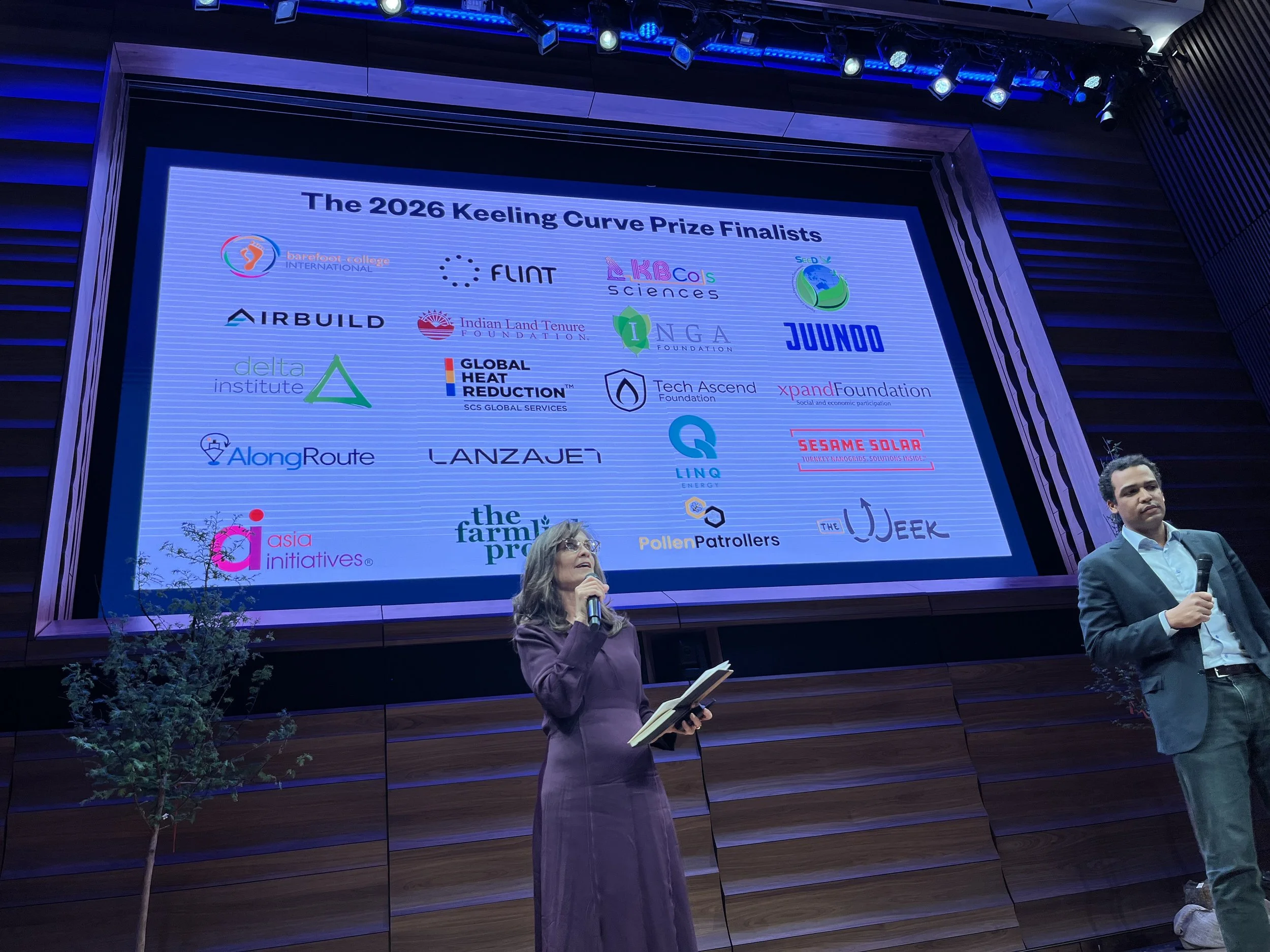
Climate Curve Executive Director Jacquelyn Francis and Time Magazine Senior Climate Correspondent Justin Worland announce the 20 finalists for the Keeling Curve Prize at the opening ceremonies for DC Climate Week. Photo by Lance Gould.
All of this optimism is, in some weird backward way, being catalyzed further by a small body of water in the Middle East: the Strait of Hormuz. The administration that has done everything to resurrect fossil fuels has stumbled into a geopolitical conflict that makes the case for energy independence more viscerally than any environmentalist ever could.
Trump's base was promised “America First” and no more foreign entanglements. Instead, they got their very own quagmire — and a reminder of exactly why tethering the American economy to Middle Eastern oil volatility was always a questionable strategy. And despite his hostility toward renewables, the President has only made them more (a word he likes very much) attractive. Every spike in energy anxiety is an advertisement for solar.
So yes, it would be dishonest to ignore the damage being done by this Administration. The cancelled grants, the hobbled agencies, the fossil fuel subsidies that persist — these have consequences that will take years to measure. And just imagine where we might be had the last election gone differently.
But enough progress has indeed been made that it cannot be easily undone. Enough capital committed that markets won't reverse on a capricious executive order. Enough solar installed, enough batteries deployed, enough corporate purchasing agreements signed, that the clean energy economy is no longer a promise — it is an infrastructure.

Solar power of sorts in Georgetown during DC Climate Week. Photo by Lance Gould
The nation’s capital tried to beat us. But it isn’t working. The people assembled for DC Climate Week are not waiting. They have had … enough cruel taking. Enough gaslighting. And now this movement has enough fuel to sustain the movement forward.
This blog was written by Brooklyn Story Lab CEO Lance Gould on his return from DC Climate Week, held April 20-26.