
Olympic Torch, Meet Nuclear Waste
The 2026 Winter Olympics have just concluded in Italy — dazzling performances on ice and snow, punctuated by the occasional over-confessional athlete and embarrassing U.S. official (here and here). But taken together, the Games once again captured the global imagination, reminding us how powerfully a single flame can unite us and hold the world’s attention.
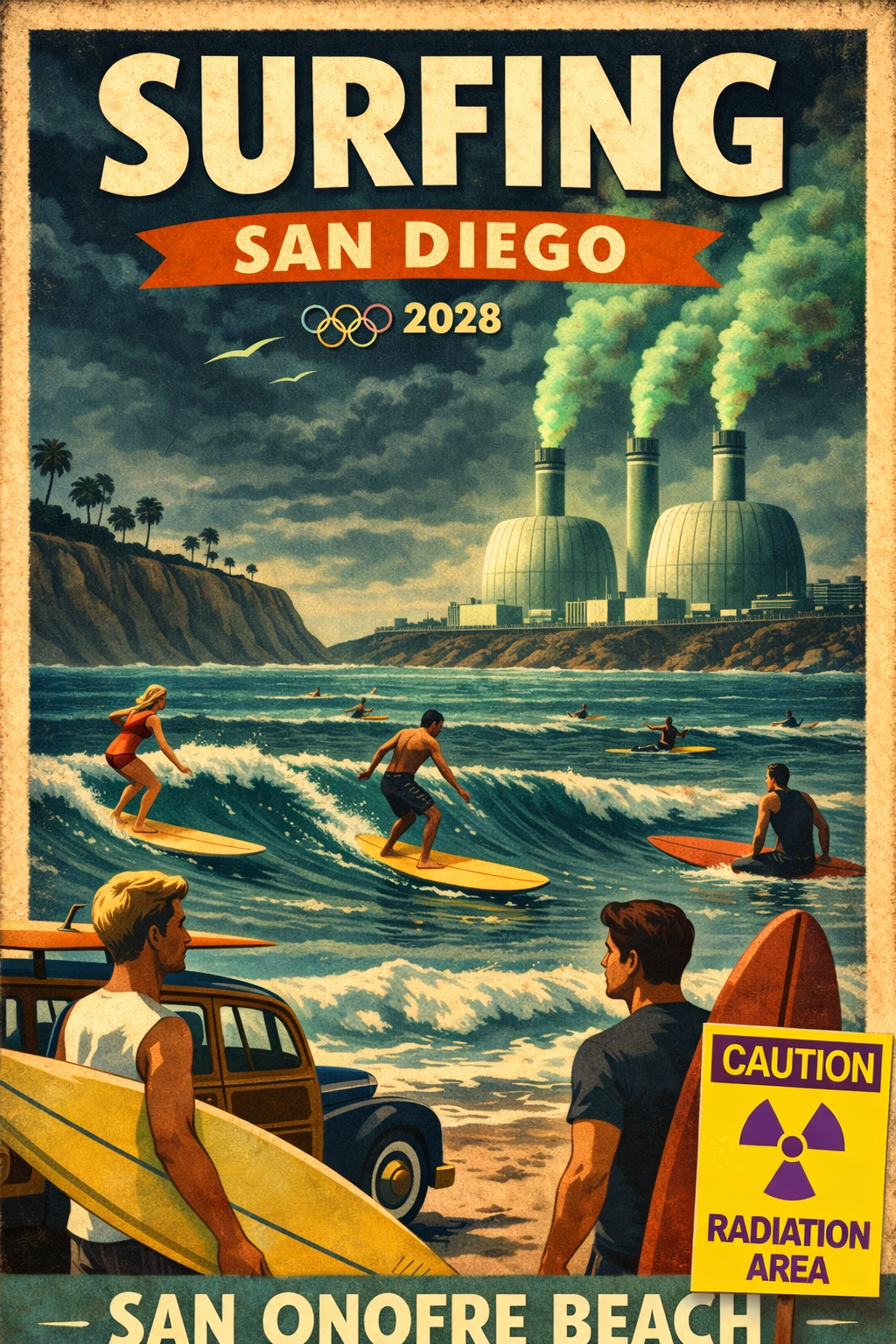
In two years, that flame will be lit in Los Angeles.
The 2028 Summer Olympics promise spectacle and pageantry, with representatives from nearly every nation on earth (at least the ones whose governments have yet to be toppled to distract us from the Epstein Files).
Unlike the 2024 Paris Games, which sent surfers halfway across the globe to Tahiti, Los Angeles will keep its surfing competition closer to home: San Onofre Beach, one of Southern California’s most iconic breaks.
San Onofre is also home to the retired San Onofre Nuclear Generating Station (SONGS).
Buried there are 3.6 million pounds of radioactive waste. Stored in aging casks. On a beach vulnerable to destructive king tides. In a region so seismically active it has earned the nickname “Earthquake Bay.”
Roughly nine million people live within a 50-mile radius.
What could possibly go wrong?
The Study We Shouldn’t Ignore
The juxtaposition of Olympic flame and retired nuclear reactors would be jarring even if nuclear power were as “clean” and “harmless” as its advocates insist. But new research suggests the story is far more complicated.
A recent Harvard T.H. Chan School of Public Health study, “Proximity to Nuclear Power Plants Associated with Increased Cancer Mortality,” found a link between living near nuclear facilities and elevated cancer death rates.
For decades, the dominant narrative around U.S. nuclear energy has been that it is tightly regulated and poses no meaningful health risk to surrounding communities. This study raises serious questions about that reassurance.
Nuclear plants are not emission-free. Routine operations release small amounts of radioactive materials into air and water. The exposure may be low-dose, but it is often chronic. Over time, small exposures accumulate.
Epidemiology detects patterns across populations — and this study suggests that proximity matters.
The research was conducted with assistance from the Radiation and Public Health Project (RPHP), a long-time partner of Brooklyn Story Lab. This is public health science examining measurable outcomes at the very moment nuclear energy is being promoted as “carbon-free” and essential to climate goals.
And the concerns extend beyond routine operations.
Every nuclear reactor produces high-level radioactive waste — spent fuel that remains dangerously radioactive for tens of thousands of years.
More than 100,000 tons of that spent fuel are currently stored at 76 sites across the United States. Yet the country still has no permanent, operational repository for that dangerous waste. Storage systems designed as temporary have quietly become indefinite.
San Onofre is not unique. It is emblematic.
The casks there were never intended to sit indefinitely on an eroding beach.
Yet in 2028, Olympic surfers will paddle out in the Pacific within just three miles of those millions of pounds of toxic, radioactive waste.
Even if a permanent repository were built somewhere in the American West, the problem would not disappear — it would simply move.
As Dr. Marvin Resnikoff noted during a recent webinar hosted by Forums for a Nuclear-Free New York — alongside environmental attorney Susan Shapiro and moderated by Brooklyn Story Lab — the Department of Energy’s plan for transporting nuclear fuel relies primarily on rail.
That would mean widespread shipment of high-level radioactive material across cities, rivers, and communities.
Do hazardous material derailments happen?
Uhhh, yes.
Rail infrastructure in the United States is aging. We have seen how difficult toxic spill cleanups can be. A radiological release would not dissipate like smoke or degrade like oil. And if it happened in an area as populated as Southern California, the consequences could be catastrophic.
A Simple Question
Nuclear power is often defended in abstract terms: grid stability, baseload generation, carbon intensity.
So make it personal. If you had the choice, would you live within 20 miles of a nuclear reactor? Would you feel comfortable raising a family there?
If the answer is hesitation, that hesitation deserves scrutiny.
We plan the Olympics years in advance. Nuclear waste demands planning for centuries.
That toxic waste will remain — long after the athletes go home and the Olympic flame is extinguished.