
A NEW YORK YANKEE IN KING FREDERIK'S COURT*
“Ladies and gentlemen, please rise for Denmark’s Prime Minister Lars Løkke Rasmussen!”
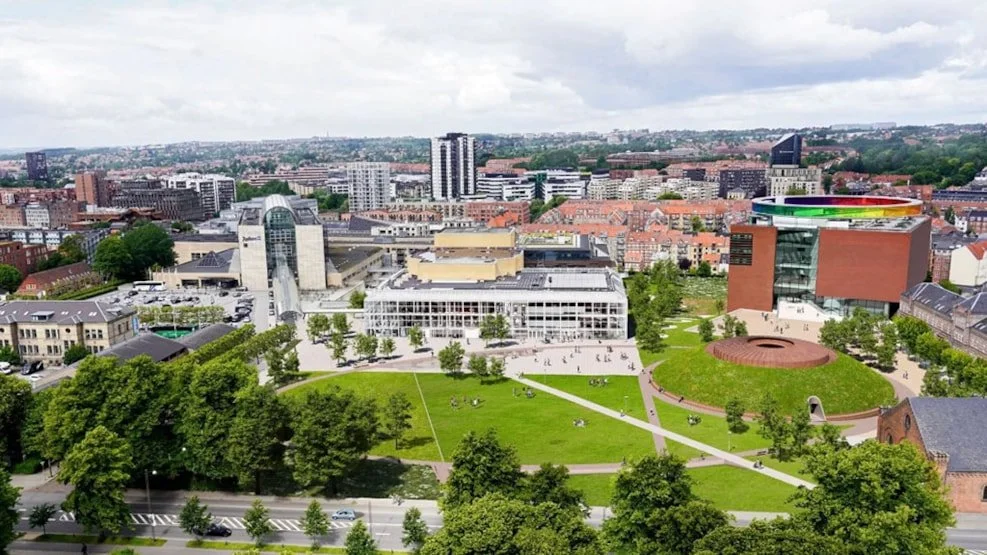
The voice of God — the theatrical term used to describe a disembodied, offstage narrator — reverberated through the 3,600-seat Musikhuset Aarhus in Denmark’s second-largest city, drawing thunderous applause as the country’s head of government entered the arena and took his seat. But for this 2017 international event on European soil — the culmination of the nine-day UNLEASH Innovation Lab, a nonprofit convening 1,000 next-generation social entrepreneurs from 150 countries — the voice was distinctly American.
It was mine.
It’s not that I have an especially mellifluous tone, a deep timbre, or even an inflection that’s remotely interesting. It’s that I was American, and the executive producer wanted the proceedings to signal a U.S. imprimatur.
I realized pretty quickly that it was my “Johnny Bravo” moment — a reference to the Brady Bunch episode in which eldest son and aspiring rock star Greg is “discovered” by a talent agent only because he “fits the suit” for the fictional Monsieur Bravo. Over the course of that August conference nine years ago, I narrated a number of events — from the opening ceremonies in Copenhagen, to smaller gatherings in the Jutland countryside, to Shark Tank–style competitions among purpose-driven young people in Aarhus — largely because of Denmark’s fascination with the United States.
At the time, that fascination felt almost reflexive — an assumption of alignment so ingrained it barely required explanation. For Denmark, the United States wasn’t just an ally but the anchor of NATO, the guarantor of a rules-based order, and a cultural force whose power was widely perceived as stabilizing rather than threatening.
“Denmark has probably been the most American-friendly country in the E.U.,” a Copenhagen-based political consultant told The New Yorker this week, in an article titled “Denmark Is Sick of Being Bullied by Trump.” The love affair between Denmark and the United States is now, like the ice sheets in Greenland, evaporating. The article notes that the U.S., “once Denmark’s closest ally, is threatening to steal Greenland and attacking the country’s wind-power industry.” It asks bluntly: “Is this a permanent breakup?”


Make it stand out
UNLEASH Innovation Lab 2017 closing ceremony co-hosts, Gaurav Gupta and June Sarpong, and “Voice of God” Lance Gould, at Aarhus Musikhuset.
Greenland — the Arctic territory governed by Denmark but largely self-ruled — is driving the current crisis. U.S. Vice President J.D. Vance and Secretary of State Marco Rubio held talks yesterday in Washington with Denmark’s foreign minister — none other than Lars Løkke Rasmussen. (Former Scandinavian prime ministers often reappear in other senior government roles; see the Denmark political drama Borgen on Netflix, particularly the final-season Greenland arc.) Rasmussen emerged from the talks citing a “fundamental disagreement” over the territory and warning that President Trump was insisting on “conquering” Greenland — a position he called “totally unacceptable.”
And almost immediately after talks ended yesterday, European troops — from France, Germany, Sweden, and Norway, among others — arrived in Greenland to bolster security there. To bolster security from the possibility of an invasion by … the United States.
The agonizing potential breakup between the U.S. and Denmark is particularly bitter for the latter, whose world-leading wind industry once symbolized transatlantic cooperation on climate — and now finds itself targeted by the very country it assumed was on the same side of the energy transition.
[Regardless of the U.S. ideology toward energy, there is a much more rewarding and less risky option for energy independence — urban mining — that does not require invading Greenland.]
There is a Texas-based Cassandra — a prophet no one wanted to believe — who saw this coming before anyone else. During his 2016 campaign against Trump for the Republican nomination, Senator Ted Cruz described Trump as unstable. “We’re liable to wake up one morning and Donald, if he were president, would have nuked Denmark,” Cruz said nine years ago.
What once sounded like a punchline now reads like contingency planning. Denmark is no longer laughing.
by Lance Gould, CEO, Brooklyn Story Lab
* In 2017, the ruling monarch of Denmark was Queen Margrethe II, but for the headline to successfully update the Mark Twain novel, we went with the country’s now leader, King Frederik X.