
DIRE STRAIT
Reflections during Earth Month on energy, vulnerability, and the greater costs of sticking with fossil fuels
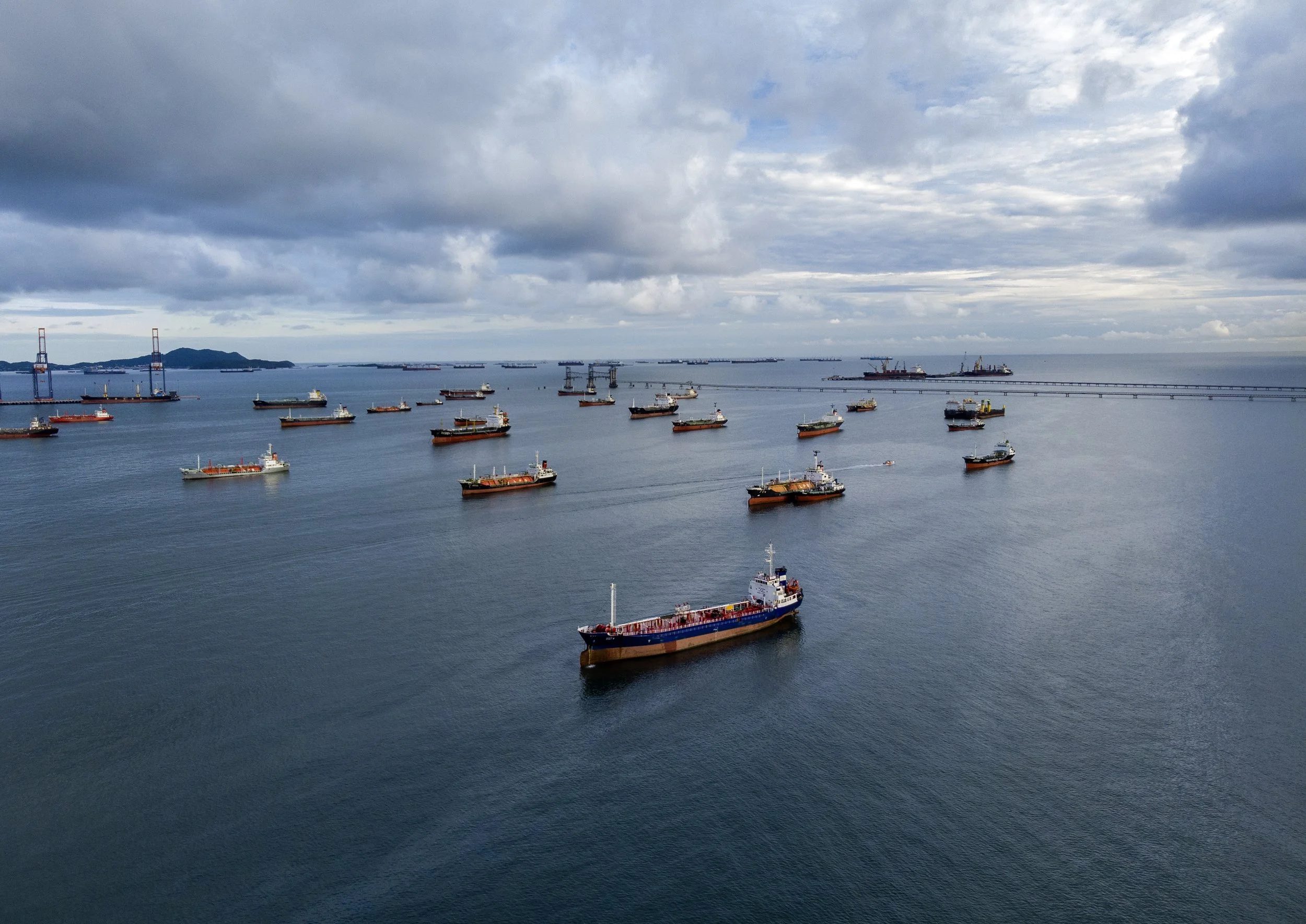
Oil tankers in the Strait of Hormuz
About 20% of the world’s oil passes through the Strait of Hormuz.
Which is fine — in the way a house of cards is fine.
A war breaks out. The strait becomes contested. The backup route runs uncomfortably close to Houthi missile fire. Suddenly, tankers hesitate. Insurance premiums spike. Markets twitch. Governments issue statements meant to sound calm — but aren’t.
And just like that, energy prices surge.
Again.
This is the part that’s hard to ignore: the global economy still runs on a backward-looking, extractive fuel system that not only heats the planet, but depends on a handful of narrow, fragile chokepoints.
Places like the Strait of Hormuz — where geopolitics, conflict, and infrastructure collide.
And where, more often than not, everyone but oil companies loses.
That raises an obvious question — one we seem to ask every time this happens, and then promptly forget:
Why?
Why, in 2026, are we still so dependent on energy sources that require drilling, shipping, and geopolitical stability — all of which are fragile, and all of which come with real costs?
Especially when the alternative is no longer theoretical.
What if there were another system, that:
didn’t rely on shipping lanes?
didn’t collapse with geopolitical reverberations?
didn’t require fuel extraction?
and didn’t heat the planet?
In fact, we do: it comprises renewables called wind, solar, and hydro.
And despite what the cynics might say, this isn’t some distant future. It’s already happening — quietly, unevenly, but undeniably.
Take island nations.
For decades, they’ve been among the most exposed — to climate change, to volatile fuel prices, to dependence on imported energy.
Now, many of them are flipping that script.
Organizations like Blue Planet Alliance are helping islands follow Hawaii’s lead: commit to 100% renewable energy, and build systems that are locally generated, resilient, and independent of global fuel markets.
It’s not just climate strategy — it’s energy sovereignty.
And it works.
Because when your energy comes from the sun above you and the wind around you, there is no strait to close. No tanker to delay. No foreign conflict to price into your electricity bill.
Flipping the Model
Meanwhile, at the global level, Stanford professor Mark Z. Jacobson and others have spent years mapping out how countries can transition entirely to renewable energy using existing technology.
He recently noted that, in 2024, 30% of the entire world's electricity came from WindWaterSolar (8.11% wind, 14.33% hydro, 0.29% geothermal, and 6.93% solar). His work — and his ongoing tracking of real-world adoption — makes one thing increasingly clear: We are much further along than most people think.
Renewables are scaling. Costs are falling. Entire regions are already generating a significant share of their energy this way.
Because the real shift here isn’t just technological — it’s conceptual.
We’ve spent over a century building an energy system based on scarcity: finite fuels, concentrated resources, controlled access.
Renewables flip that model. They’re abundant. Distributed. Local.
Which means they don’t just change how we power our homes — they change how vulnerable we are as a global system.
So when the next crisis hits — and with this administration, that could be … Tuesday? — the question shouldn’t be how quickly we can reroute tankers or stabilize prices.
It should be why we’re still this exposed in the first place.
Earth Month tends to focus on emissions, which makes sense.
But maybe it should also be about resilience.
About building a world where energy doesn’t depend on narrow straits or distant conflicts.
A world where the lights stay on not because global shipping lanes are secure — but because the sun rose that morning, and the wind kept blowing.
Someone really ought to look into that.
Oh, wait…